Accident Prevention ProgramDENSITY ALTITUDEWhen it comes to good old-fashioned hangar flying sessions, one subject that almost never seems to be discussed is density altitude. The reason being, too many pilots do not know enough about the subject. Yet, because of the unescapable influence density altitude has on aircraft and engine performance, it is important for every pilot to understand its effects. Hot, high, and humid weather conditions can change a routine takeoff or landing into an accident in less time than it takes to tell about it. There are three important factors that affect air density.
Density altitude effects are not confined to mountain areas. They also apply at elevations near sea level when temperatures go above standard 59 degrees F or 15 degrees C). It's just that the effects are increasingly dramatic at the higher elevations. Takeoff distance, power available (in normally aspirated engines), and climb rate are all adversely affected, and while the indicated airspeed remains the same, the true airspeed increases. Too often, a pilot who is flying in high density altitude conditions for the first time in an aircraft with a normally aspirated engine becomes painfully aware of the retarded effect on the aircraft performance capabilities. Additionally, at power settings of less than 75%, or at density altitudes above 5,000 feet, it is essential that normally aspirated engines be leaned for maximum power on takeoff unless equipped with an automatic altitude mixture control. Otherwise, the excessively rich mixture adds another detriment to overall performance. Turbocharged engines, on the other hand, need not be leaned for takeoff in high density altitude conditions because they are capable of producing manifold pressure equal to or higher than sea level pressure. Density altitude is not to be confused with pressure altitude, indicated altitude, true altitude or absolute altitude, and is not to be used as a height reference, but will be used as determining criteria for the performance capabilities of the aircraft. The published performance criteria in the Pilot's Operating Handbook is generally based on standard atmospheric conditions at sea level (59 degrees F to 15 degrees C and 29.92 inches of mercury). When the temperature rises above the standard temperature for the locality, the density of the air in that locality is reduced and the density altitude increases. This affects the aircraft aerodynamic performance, and decreases the horsepower Output of the engine. Pilots should; make a practice of checking their aircraft performance charts during preflight preparation. This is important when temperatures are above normal regardless of airport elevation. This chart gives a rule of thumb example of temperature affects on density altitude.
From the pilot's point of view, an increase in density altitude results in:
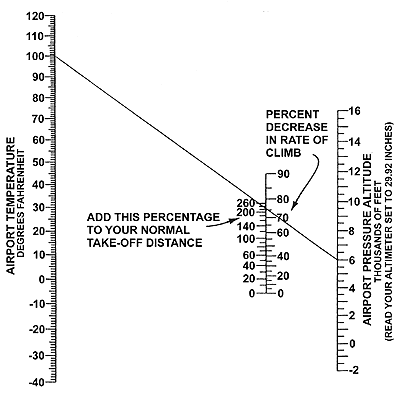
At airports of higher elevations, such as those in the Western United States, high temperatures sometimes have such an effect on density altitude that safe operations are impossible. In such conditions, operations between midmorning and midafternoon can become extremely hazardous. Even at lower elevations, aircraft performance can become marginal and it may be necessary to reduce aircraft gross weight for safe operations. Therefore, it is advisable, when performance is in question, to schedule operations during the cool hours of the day, early morning or late afternoon, when forecast temperatures are expected to rise above normal. Early morning and late evening are sometimes more ideal for both departure and arrival. A pilot's first reference for aircraft performance information should be the operational data section of the Aircraft Owner's Manual or the Pilot's Operating Handbook developed by the aircraft manufacturer. When these references are not available, the Koch Chart may be used to figure the approximate temperature and altitude adjustments for aircraft takeoff distance and rate of climb. The Koch Chart for Altitude and Temperature EffectsTo find the effect of altitude and temperature, connect the temperature and airport altitude by a straight line. Read the increase in take-off distance and the decrease in rate of climb from standard sea level values.
Example: The diagonal line shows that 230% must be added for a temperature of 100 degrees and a pressure altitude of 6,000 feet. Therefore, if your standard temperature sea level take-off distance, in order to climb to 50 feet, normally requires 1,000 feet of runway, it would become 3,300 feet under the conditions shown. In addition, the rate of climb would be decreased 76%. Also, if your normal sea level rate of climb is 500 feet per minute, it would become 120 feet per minute. This chart indicates typical representative values for "personal" airplanes. For exact values consult your airplane flight manual. The chart may be conservative for airplanes with supercharged engines. Also remember that long grass, sand, mud or deep snow can easily double your take-off distance. (END OF DOCUMENT FAA-P-8740-2 AFS-800-0478) |