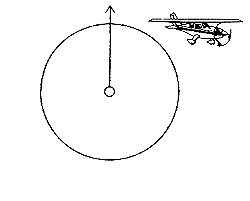
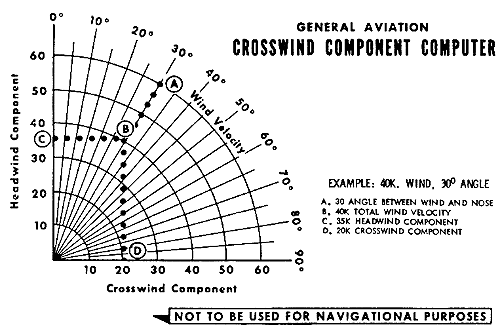
Accident Prevention ProgramMEET YOUR AIRCRAFTPurpose This quiz is designed to aid a pilot in understanding the aircraft he flies. Although no attempt is made to cover in depth all information contained In the typical Owner's Manual, this booklet will provide a review of the basic information a pilot should know before taking off on a crosscountry flight. Since the questions are designed to be answered in an open book fashion, no minimum passing score is set, although it is assumed that a pilot holding at least a private license would score high. It is suggested that, in addition to the review provided by this booklet, a thorough, periodic review be made of the Owner's Manual. Instructions Name______________________________________________ Date__________________ Airman's Make__________________ Model_________________ certificate_______________ Medical certificate Ratings_____________________________ type-expiration date________________ Time in Total time______ Last 90 days________ make & model______________________ Date of latest biannual flight review_____________________ 1. What is the normal climbout speed?____________________ 2. What is the best rate of climb speed?_________________ 3. What is the best angle of climb speed?________________ 4. What is the maximum flap-down speed?__________________ 5. What is the maximum gear-down speed?__________________ 6. What is the stall speed in a normal landing configuration?______________ 7. What is the clean-stall speed?________________________ 8. What is the approach-to-landing speed?________________ 9. What is the maneuvering speed?________________________ 10. What is the red-line speed?__________________________ 11. What engine off glide speed wlll give you the maximum range?___________ 12. (Multi-engine only) What is the VMC?_________________ 13. What is the make and horsepower of the engine(s)?_______________________ ________Hp. 14. What is the estimated TAS at 5,000 ft. and 65% power?__________________ 15. What RPM or combination of RPM and Manifold Pressure yields 65% power at 5000'MSL?____________RPM &_____________________MP 16. How many gallons of fuel are used per hour at 65% power at 5000' MSL?_______________________ 17. How marry Usable gallons of fuel can you carry?_________________ 18. Where are the fuel tanks located, and what are their capacities? Main tank__________________________________ gallons____________ Left tank__________________________________ gallons____________ Right tank_________________________________ gallons____________ Rear tank__________________________________ gallons____________ Auxiliary tank #l__________________________ gallons____________ Auxiliary tank #2__________________________ gallons____________ 19. (Multi-englne only) In the event an engine fails, can all on-board fuel be fed to the running engine?__________If yes, explain how: __________________________________________________________________ 20. With full fuel load at 65% power, at 5,000 ft., allowing a 45 minute reserve, what is the maximum duration (In hours)?___________________ 21. What speed will glve you the best glide ratio?______________________ 22. What is the octane rating of the fuel used by thls aircraft?________ 23. How do you drain the fuel sumps?____________________________________ 24. What weight of oil is being used?___________________________________ 25. Is the landing gear fixed, manual, hydraulic, or electric?__________ If retractable, what is the back-up system for lowering the gear? ____________________________________________________________________ 26. What is the maximum allowable crosswind component for the aircraft? ____________________________________________________________________ 27. How many people will this aircraft carry safely with a full fuel load? ______________________________________________________________________ 28. What is the maximum allowable weight the aircraft can carry in the baggage compartment(s)? Rear______________________________________lbs. Front ____________________________________lbs. Belly_____________________________________lbs. Left engine nacelle_______________________lbs. Right engine nacelle______________________lbS. Total_____________________________________lbs. 29. What take-off distance is requlred to clear a 50 ft. obstacle at maximum gross weight at a pressure altitude of 5,000 ft. and 15 degrees (F)? (Assume no wind and a hard surface runway.)______ft. 30. What would the answer to number 29 be if the take-off were made from a sea level pressure altitude?__________ft. 31. Would high humidity increase or decrease this distance?__________ 32. How do you find pressure altitude?_______________________________ 33. What is your maximum allowable useful load? (Check the weight and balance data in the aircraft, not the Owner's Manual.)________Ibs. 34. Solve the weight and balance problem for the flight you plan to make. If you plan to fly solo, solve for a 170 Ib. passenger In each seat. Does your load fall within the weight and balance envelope?__________ What is your gross weight?_____________Ibs. If you solved the problem contemplating 170 Ib. passengers in each seat, how much fuel could you carry?________ Where?____________________________________________ _____________________________________________________________________ If you carry full fuel how much baggage could you carry?__________Ibs. Where?________________________________________________________________ 35. Where can you find an FSS phone number?_______________________________ 36. List two frsquencies you can use to contact the FSS: Transmit Receive 1.________________ ________________ 2.________________ ________________ 37. What is the emergency frequency?_______________________ 38. To operate a fixed wing aircraft in a Group1 TCA, the aircraft must have the following equipment: 1.__________________________________________________________________ 2. An operable two-way radio capable of communicating with the appropriate ATC facility.________________________________________ 3. An operable coded radar beacon transponder having automatic pressure altitude reporting capability.___________________________________ 39. What are the minimum FAR requirements for a pilot to legally carry passengers?_________________________________________________________ 40. What is the present ceiling and surface wind at YTR? YTR SA2200 50SCT lOOBKN 250BKN 12 128123116123041991 ____________________________________________________________________ 41. On the weather sequence reports the wind speed is given in knots; how is visibility measured, in nautical miles or statute miles? ____________________________________________________________________ 42. Assuming the aircraft shown below is tuned to the VOR pictured and the VOR receiver OBS is set on 45 degrees, is the To-From read-out reading To or From?____________________
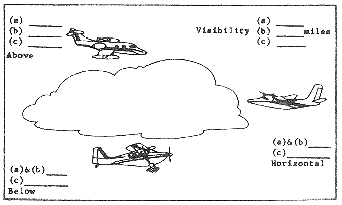
43. Fill in the blanks below, indicating cloud clearances and visibillty required by the Federal Air Regulations (a) within and (b) outside controlled airspace, and (c) more than 1200 ft. above the surface and over 10,000 MSL.
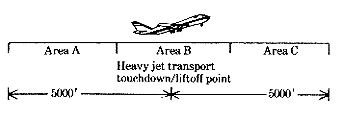
Use the drawing below for the next two questions.
44. If you must take off following a departing jet transport on the same runway, in what area should you plan your lift off? Area A, B, or C?_______________________ 45. If you must land behind a landing jet transport, where should you aim for touchdown? Area A, B, or C?___________________
Standardization +Attitude +Familiarity +Experience +Technigue +YOU ...makes it all add up in your favor! (END OF DOCUMENT FAA-P-8740-29 AFO-800-0680) |