|
CHAPTER 5 - WEATHER
INTRODUCTION Despite all the technological advancements, safety in flight is still subject to weather conditions such as limited visibility, turbulence, and icing. One may wonder why pilots need more than general information available from the predictions of the meteorologist. The answer is well known to the experienced pilot. Meteorologists' predictions are based upon movements of large air masses and upon local conditions at points where weather stations are located. Air masses at times are unpredictable, and weather stations in some areas are spaced rather widely apart. Therefore, pilots must understand the conditions that could cause unfavorable weather to occur between the stations, as well as the conditions that may be different from those indicated by weather reports. Furthermore, the meteorologist can only predict the weather conditions; the pilot must decide whether the particular flight may be hazardous, considering the type of aircraft being flown, equipment used, flying ability, experience, and physical limitations. Weather service to aviation is a combined effort of the National Weather Service (NWS), the Federal Aviation Administration (FAA), the Department of Defense (DOD), and other aviation groups and individuals. Because of the increasing need for worldwide weather services, foreign weather services also have a vital input into our service. This chapter is designed to help the pilot acquire a general background of weather knowledge and the principles upon which sound judgment can be built as experience is gained and further study is undertaken. There is no substitute for experience in any flight activity, and this is particularly true if good judgment is to be applied to decisions concerning weather. OBSERVATIONS Weather observations are measurements and estimates of existing weather both at the surface and aloft. When recorded and transmitted, an observation becomes a report, and these reports are the basis of all weather analyses and forecasts. Surface Aviation Weather Observations Surface aviation weather observations include elements pertinent to flying. A network of airport stations provides routine up-to-date surface weather information. Automated surface observing systems (ASOS), automated weather observing systems (AWOS), and other automated weather observing systems are becoming a major part of the surface weather observing network. Upper Air Observations Upper air observations are data received from sounding balloons (known as radiosonde observations) and pilot weather reports (PIREPs). Upper air observations are taken twice daily at specified stations. These observations furnish temperature, humidity, pressure, and wind data. In addition, pilots are a vital source of upper air weather observations. In fact, aircraft in flight are the only means of directly observing turbulence, icing, and height of cloud tops. Radar Observation Precipitation reflects radar signals which are displayed as echoes on the radar scope. The use of radar is particularly helpful in determining the exact location of storm areas. Except for some mountainous terrain, radar coverage is complete over the contiguous 48 states. A radar remote weather display system (RRWDS) is specifically designed to provide real-time radar weather information from many different radars. A radar system that uses Doppler technology is being installed across the United States. This radar gives greater detail and enhanced information about thunderstorms and weather systems. SERVICE OUTLETS A weather service outlet as used here is any facility, either government or private, that provides aviation weather service to users. Information concerning some of the service outlets provided by the FAA follows. FAA Flight Service Station (FSS) The FAA flight service station provides more aviation weather briefing services than any other government service outlet. They provide preflight and inflight briefings, make scheduled and unscheduled weather broadcasts, and furnish weather advisories to flights within the FSS area. The FAA has modernized its FSS program. Automated flight service stations (AFSS) are becoming abundant, with about one per state, with lines of communications radiating out from it. Pilot's Automatic Telephone Weather Answering System (PATWAS) Pilot's automatic telephone weather answering system is a recorded telephone briefing with the forecast for the local area, usually within a 50 nautical mile radius of the station. Transcribed Information Briefing Service (TIBS) Transcribed information briefing service is provided by AFSS's and provides continuous telephone recordings of meteorological and/or aeronautical information. Specifically, TIBS provides area and/or route briefings, airspace procedures, and special announcements, if applicable. Other items may be included depending on user demand. Direct User Access Terminal Service (DUATS) A direct user access terminal service is an FAA-operated information system which enables pilots and other aviation interests to conduct their own weather briefings. The computer-based system receives and stores a number of NWS and FAA products which are commonly used in weather briefings. Pilots using a personal computer and modem can access the system and request weather and other pertinent data as well as file or amend flight plans. Transcribed Weather Broadcast (TWEB) A transcribed weather broadcast is a continuous broadcast on low/medium frequencies (190 to 535 kHz) and selected VORs (108.0 to 117.95 MHz). WEATHER BRIEFING Obtaining a good weather briefing is in the interest of safety. It is the pilot's responsibility to ensure all the needed information is obtained to make a safe flight. When requesting a briefing, pilots should identify themselves and provide as much information regarding the proposed flight as possible. The information received will depend on the type of briefing requested. The following would be helpful to the briefer.
Standard Briefing should include:
Abbreviated Briefing An abbreviated briefing will be provided at the user's request to supplement mass disseminated data, to update a previous briefing, or to request specific information only. Outlook Briefing An outlook briefing will be provided when the briefing is 6 or more hours in advance of the proposed departure time. It will be limited to applicable forecast data for the proposed flight. NATURE OF THE ATMOSPHERE Life exists at the bottom of an ocean of air called the atmosphere. This ocean extends upward from the Earth's surface for many miles, gradually thinning as it nears the top. Near the surface, the air is relatively warm from contact with the Earth. The temperature in the United States averages about 15° C (59° F) the year round. As altitude increases, the temperature decreases by about 2° C (3.5° F) for every 1,000 feet (normal lapse rate) until air temperature reaches about –55° C (–67° F) at 7 miles above the Earth. For flight purposes, the atmosphere is divided into two layers: the upper layer, where temperature remains practically constant, is the " stratosphere;" the lower layer, where the temperature changes, is the "troposphere." Although jets routinely fly in the stratosphere, the private pilot usually has no occasion to go that high, but usually remains in the lower layer-the troposphere. This is the region where all weather occurs and practically all light airplane flying is done. The top of the troposphere lies 5 to 10 miles above the Earth's surface. [Figure 5-1] Obviously, a body of air as deep as the atmosphere has tremendous weight. It is difficult to realize that the normal sea level pressure upon the body is about 15 pounds per square inch, or about 20 tons on the average person. The body does not collapse because this pressure is equalized by an equal pressure within the body. In fact, if the pressure were suddenly released, the human body would explode. As altitude is gained, the temperature of the air not only decreases (it is usually freezing above 18,000 feet) but the air density also decreases; therefore there is less pressure. Pressure is rapidly reduced up to 18,000 feet where the pressure is only half as great as at sea level.
Oxygen and the Human Body The atmosphere is composed of about four-fifths nitrogen and one-fifth oxygen, with approximately one percent of various other gases. Oxygen is essential to human life. At 18,000 feet, with only half the normal atmospheric pressure, the body intake of oxygen would be only half the normal amount. Body reactions would be definitely below normal, and unconsciousness might result. In fact, the average person's reactions become affected at 10,000 feet and may be affected at altitudes as low as 5,000 feet. To overcome these unfavorable conditions at high altitudes, pilots use oxygen-breathing equipment and wear protective clothing, or fly in pressurized cabins in which temperature, pressure, and oxygen content of the air can be maintained within proper range. Significance of Atmospheric Pressure The average pressure exerted by the atmosphere is approximately 15 pounds per square inch at sea level. This means that a column of air 1 inch square extending from sea level to the top of the atmosphere would weight about 15 pounds. The actual pressure at a given place and time, however, depends upon several factors. These are altitude, temperature, and density of the air. These conditions definitely affect flight. Measurement of Atmospheric Pressure A barometer is generally used to measure the height of a column of mercury in a glass tube. It is sealed at one end and calibrated in inches. An increase in pressure forces the mercury higher in the tube; a decrease allows some of the mercury to drain out, reducing the height of the column. In this way, changes of pressure are registered in inches of mercury (in. Hg.). The standard sea level pressure expressed in these terms is 29.92 inches at a standard temperature of 15° C (59° F). The mercury barometer is cumbersome to move and difficult to read. A more compact, more easily read, and more mobile barometer is the aneroid, although it is not so accurate as the mercurial. The aneroid barometer is a partially evacuated cell sensitive to pressure changes. The cell is linked to an indicator which moves across a scale graduated in pressure units. If all weather stations were at sea level, the barometer readings would give a correct record of the distribution of atmospheric pressure at a common level. To achieve a common level, each station translates its barometer reading into terms of sea level pressure. A change of 1,000 feet of elevation makes a change of about 1 inch on the barometer reading. Thus, if a station located 5,000 feet above sea level found the mercury to be 25 inches high in the barometer tube, it would translate and report this reading as 30 inches. [Figure 5-2] Since the rate of decrease in atmospheric pressure is fairly constant in the lower layers of the atmosphere, the approximate altitude can be determined by finding the difference between pressure at sea level and pressure at the given atmospheric level. In fact, the aircraft altimeter is an aneroid barometer with its scale in units of altitude instead of pressure. Effect of Altitude on Atmospheric Pressure It can be concluded that atmospheric pressure decreases as altitude increases. It can also be stated that pressure at a given point is a measure of the weight of the column of air above that point. As altitude increases, pressure diminishes as the weight of the air column decreases. This decrease in pressure (increase in density altitude) has a pronounced effect on flight. Effect of Altitude on Flight The most noticeable effect of a decrease in pressure, due to an altitude increase, becomes evident in takeoffs, rate of climb, and landings. An airplane that requires a 1,000-foot run for takeoff at a sea level airport will require a run almost twice as long to take off at an airport which is approximately 5,000 feet above sea level. The purpose of a takeoff run is to gain enough speed to generate lift from the passage of air over the wings. If the air is thin, more speed is required to obtain enough lift for takeoff -- hence, a longer ground run. It is also true that the engine is less efficient in thin air, and the thrust of the propeller is less effective. The rate of climb is also slower at the higher elevation, requiring a greater distance to gain the altitude necessary to clear any obstructions. In landing, the difference is not so noticeable except that the plane has greater groundspeed when it touches the ground. [Figures 5-3 and 5-4]
Figure 5-3. -- Atmospheric density at sea level enables an airplane to take off in a relatively short distance.
Figure 5-4. -- The distance required for takeoff increases with the altitude of the field.
Effect of Differences in Air Density Differences in air density caused by changes in temperature result in changes in pressure. This, in turn, creates motion in the atmosphere, both vertically and horizontally (current and winds). This action, when mixed with moisture, produces clouds and precipitation - in fact, these are the phenomena called “weather.” Pressure Recorded in “Millibars” The mercury barometer reading at the individual weather stations is converted to the equivalent sea level pressure and then translated from terms of inches of mercury to a measure of pressure called millibars. One inch of mercury is equivalent to approximately 34 millibars; hence, the normal atmospheric pressure at sea level (29.92), expressed in millibars, is 1,013.2 or roughly 1,000 millibars. The usual pressure readings range from 950.0 to 1,040.0. Individually these pressure readings are of no particular value to the pilot; but when pressures at different stations are compared, or when pressures at the same station show changes in successive readings, it is possible to determine many symptoms indicating the trend of weather conditions. In general, a falling pressure indicates the approach of bad weather and a rising pressure indicates a clearing of the weather. Wind The pressure and temperature changes discussed in the previous section produce two kinds of motion in the atmosphere - vertical movement of ascending and descending currents, and horizontal flow known as “wind.” Both of these motions are of primary interest to the pilot because they affect the flight of aircraft during takeoff, landing, climbing, and cruising flight. These motions also bring about changes in weather, which require a pilot to determine if a flight can be made safely. Conditions of wind and weather occurring at any specific place and time are the result of the general circulation in the atmosphere. This will be discussed briefly in the following pages. The atmosphere tends to maintain an equal pressure over the entire Earth, just as the ocean tends to maintain a constant level. When the equilibrium is disturbed, air begins to flow from areas of higher pressure to areas of lower pressure. The cause of atmospheric circulation The factor that upsets the normal equilibrium is the uneven heating of the Earth. At the Equator, the Earth receives more heat than in areas to the north and south. This heat is transferred to the atmosphere, warming the air and causing it to expand and become less dense. Colder air to the north and south, being more dense, moves toward the Equator forcing the less dense air upward. This air in turn becomes warmer and less dense and is forced upward, thus establishing a constant circulation that might consist of two circular paths; the air rising at the Equator, traveling aloft toward the poles, and returning along the Earth's surface to the Equator, as shown in figure 5-5.
This theoretical pattern, however, is greatly modified by many forces, a very important one being the rotation of the Earth. In the Northern Hemisphere, this rotation causes air to deflect to the right of its normal path. In the Southern Hemisphere, air is deflected to the left of its normal path. For simplicity, this discussion will be confined to the motion of air in the Northern Hemisphere. [Figure 5-6]
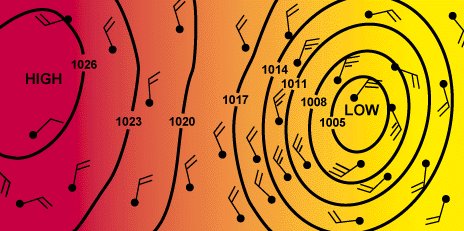
As the air rises and moves northward from the Equator, it is deflected toward the east, and by the time it has traveled about a third of the distance to the pole, it is no longer moving northward, but eastward. This causes the air to accumulate in a belt at about latitude 30°, creating an area of high pressure. Some of this air is then forced down to the Earth's surface, where part flows southwestward, returning to the Equator, and part flows northeastward along the surface. A portion of the air aloft continues its journey northward, being cooled en route, and finally settles down near the pole, where it begins a return trip toward the Equator. Before it has progressed very far southward, it comes into conflict with the warmer surface air flowing northward from latitude 30°. The warmer air moves up over a wedge of the colder air, and continues northward, producing an accumulation of air in the upper latitudes. Further complications in the general circulation of the air are brought about by the irregular distribution of oceans and continents, the relative effectiveness of different surfaces in transferring heat to the atmosphere, the daily variation in temperature, the seasonal changes, and many other factors. Regions of low pressure, called "lows," develop where air lies over land or water surfaces that are warmer than the surrounding areas. In India, for example, a low forms over the hot land during the summer months, but moves out over the warmer ocean when the land cools in winter. Lows of this type are semipermanent, however, and are less significant to the pilot than the " migratory cyclones" or "cyclonic depressions" that form when unlike air masses meet. These lows will be discussed later in this chapter. Wind Patterns This is a discussion of wind patterns associated with areas of high and low pressure. As previously stated, air flows from an area of high pressure to an area of low pressure. In the Northern Hemisphere, during this flow, the air is deflected to the right. Therefore, as the air leaves the high pressure area, it is deflected to produce a clockwise circulation. As the air flows toward the low pressure area, it is deflected to produce a counterclockwise flow around the low pressure area. Another important aspect is that air moving out of a high pressure area depletes the quantity of air. Therefore, highs are areas of descending air. Descending air favors dissipation of cloudiness; hence the association, high pressure -- good weather. By similar reasoning, when air converges into a low pressure area; it cannot go outward against the pressure gradient, nor can it go downward into the ground; it must go upward. Rising air is conducive to cloudiness and precipitation; thus the general association low pressure -- bad weather. A knowledge of these patterns frequently enables a pilot to plan a course to take advantage of favorable winds, particularly during long flights. In flying from east to west, for example, the pilot would find favorable winds to the south of a high, or to the north of a low. It also gives the pilot a general idea of the type of weather to expect relative to the “highs” and “lows.” [Figures 5-7 and 5-8]
Figure 5-8. -- Use of favorable winds in flight.
The theory of general circulation in the atmosphere, and the wind patterns formed within areas of high pressure and low pressure have been discussed. These concepts account for the large scale movements of the wind, but do not take into consideration the effects of local conditions that frequently cause drastic modifications in wind direction and speed near the Earth's surface.
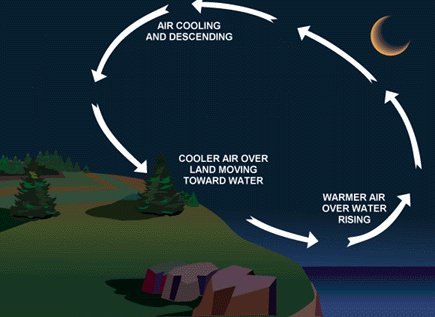
Convection Currents Certain kinds of surfaces are more effective than others in heating the air directly above them. Plowed ground, sand, rocks, and barren land give off a great deal of heat, whereas water and vegetation tend to absorb and retain heat. The uneven heating of the air causes small local circulations called "convection currents," which are similar to the general circulation just described. This may be particularly noticeable over land adjacent to a body of water. During the day, air over land becomes heated and less dense; colder air over water moves in to replace it forcing the warm air aloft and causing an on-shore wind. At night, the land cools, and the water is relatively warmer. The cool air over the land, being heavier, then moves toward the water as an off-shore wind, lifting the warmer air and reversing the circulation. [Figures 5-9 and 5-10] Convection currents cause the bumpiness experienced by pilots flying at low altitudes in warmer weather. On a low flight over varying surfaces, the pilot will encounter updrafts over pavement or barren places and downdraft over vegetation and water. Ordinarily, this can be avoided by flight at higher altitudes. When the larger convection currents form cumulus clouds, the pilot will invariably find smooth air above the cloud level. [Figure 5-11]
Figure 5-11. -- Avoiding turbulence caused by convection currents by flying above the cloud level.
Convection currents also cause difficulty in making landings, since they affect the rate of descent. For example, a pilot flying a normal glide frequently tends to land short of or overshoot the intended landing spot, depending upon the presence and severity of convection currents. [Figures 5-12 and 5-13]
Figure 5-13. -- Descending currents prevail above some surfaces and tend to cause the pilot to land short of the field.
The effects of local convection, however, are less dangerous than the turbulence caused when wind is forced to flow around or over obstructions. The only way for the pilot to avoid this invisible hazard is to be forewarned, and to know where to expect unusual conditions. Effect of Obstructions on Wind When the wind flows around an obstruction, it breaks into eddies - gusts with sudden changes in speed and direction - which may be carried along some distance from the obstruction. A pilot flying through such turbulence should anticipate the bumpy and unsteady flight that may be encountered. This turbulence - the intensity of which depends upon the size of the obstacle and the velocity of the wind - can present a serious hazard during takeoffs and landings. For example, during landings, it can cause an aircraft to " drop in;" during takeoffs, it could cause the aircraft to fail to gain enough altitude to clear low objects in its path. Any landings or takeoffs attempted under gusty conditions should be made at higher speeds, to maintain adequate control during such conditions. [Figure 5-14] This same condition is more noticeable where larger obstructions such as bluffs or mountains are involved. As shown in figure 5-15, the wind blowing up the slope on the windward side is relatively smooth, and its upward current helps to carry the aircraft over the peak. The wind on the leeward side, following the terrain contour, flows definitely downward with considerable turbulence and would tend to force an aircraft into the mountain side. The stronger the wind, the greater the downward pressure and the accompanying turbulence. Consequently, in approaching a hill or mountain from the leeward side, a pilot should gain enough altitude well in advance. Because of these downdrafts, it is recommended that mountain ridges and peaks be cleared by at least 2,000 feet. If there is any doubt about having adequate clearance, the pilot should turn away at once and gain more altitude. Between hills or mountains, where there is a canyon or narrow valley, the wind will generally veer from its normal course and flow through the passage with increased velocity and turbulence. A pilot flying over such terrain needs to be alert for wind shifts, and particularly cautious if making a landing.
Figure 5-15. -- Airplanes approaching hills or mountains from windward are helped by rising currents. Those approaching from leeward encounter descending currents.
Low-Level Wind Shear Wind shear is best described as a change in wind direction and/or speed within a very short distance in the atmosphere. Under certain conditions, the atmosphere is capable of producing some dramatic shears very close to the ground; for example, wind direction changes of 180° and speed changes of 50 knots or more within 200 feet of the ground have been observed. This, however, is not something encountered every day. In fact, it is unusual, which makes it more of a problem. It has been thought that wind cannot affect an aircraft once it is flying except for drift and groundspeed. This is true with steady winds or winds that change gradually. It isn't true, however, if the wind changes faster than the aircraft mass can be accelerated or decelerated. The most prominent meteorological phenomena that cause significant low-level wind shear problems are thunderstorms and certain frontal systems at or near an airport. Basically, there are two potentially hazardous shear situations. First, a tailwind may shear to either a calm or headwind component. In this instance, initially the airspeed increases, the aircraft tends to pitch up, and the altitude may increase. Second, a headwind may shear to a calm or tailwind component. In this situation, initially the airspeed decreases, the aircraft pitches down, and the altitude decreases. Aircraft speed, aerodynamic characteristics, power/weight ratio, powerplant response time, and pilot reactions along with other factors have a bearing on wind shear effects. It is important, however, to remember that shear can cause problems for any aircraft and any pilot. There are two atmospheric conditions that cause the type of low-level wind shear discussed herein. They are thunderstorms and fronts. The winds around a thunderstorm are complex. Wind shear can be found on all sides of a cell. The wind shift line or gust front associated with thunderstorms can precede the actual storm by up to 15 nautical miles. Consequently, if a thunderstorm is near an airport of intended landing or takeoff, low-level wind shear hazards may exist. At some large airports a low-level wind shear alert system (LLWAS) has been installed which aids in detecting wind shear. While the direction of the winds above and below a front can be accurately determined, existing procedures do not provide precise and current measurements of the height of the front above an airport. The following is a method of determining the approximate height of the front, with the consideration that wind shear is most critical when it occurs close to the ground.
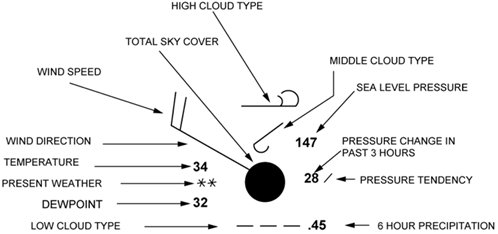
The pilot should be alert to the possibilities of low-level wind shear at any time the conditions stated are present. Wind and Pressure Representation on Surface Weather Maps The excerpted portion of a surface weather map provides information about winds at the surface. The wind direction at each station is shown by an arrow. The arrowhead is represented by the station circle, and points in the direction toward which the wind is blowing. Winds are given the name of the direction from which they blow; a northwest wind is a "wind blowing from the northwest." [Figure 5-16]
Windspeed is shown by "barbs" and/or "pennants" placed on the end of the arrow. The speed is indicated by the number of half barbs, full barbs, or pennants. Each half barb represents approximately 5 knots, each full barb indicates approximately 10 knots, and each pennant 50 knots. Thus two and one-half barbs indicate a windspeed of approximately 25 knots; a pennant and two and one-half barbs indicate a windspeed of approximately 75 knots, etc. The pilot can thus tell at a glance, the wind conditions prevailing at map time at any weather station. Pilots can obtain this information and forecasts of expected winds from all weather reporting stations. The pressure at each station is recorded on the weather map, and lines (isobars) are drawn to connect points of equal pressure. Many of the lines make complete circles to surround pressure areas marked "H" (high) or "L" (low). Isobars are quite similar to the contour lines appearing on aeronautical charts. However, instead of indicating altitude of terrain and steepness of slopes, isobars indicate the amount of pressure and steepness of pressure gradients. If the gradient (slope) is steep, the isobars will be close together, and the wind will be strong. If the gradient is gradual, the isobars will be far apart, and the wind gentle. [Figure 5-17] Isobars furnish valuable information about winds in the first few thousand feet above the surface. Close to the Earth, wind direction is modified by the contours over which it passes, and windspeed is reduced by friction with the surface. At levels 2,000 or 3,000 feet above the surface, however, the speed is greater and the direction is usually parallel to the isobars. Thus, while wind arrows on the weather map excerpt indicate wind near the surface, isobars indicate winds at slightly higher levels. [Figure 5-16] In the absence of specific information on upper wind conditions, the pilot can often make a fairly reasonable estimate of the wind conditions in the lower few thousand feet on the basis of the observed surface wind. Generally, it will be found that the wind at an altitude of 2,000 feet above the surface will veer about 20° to 40° to the right and almost double in speed. The veering will be greatest over rough terrain and least over flat surfaces. Thus, a north wind of 20 knots at the airport would be likely to change to a northeast wind of 40 knots at 2,000 feet. This subject will be reviewed later in this chapter.
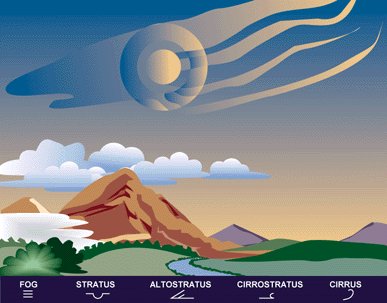
MOISTURE AND TEMPERATURE The atmosphere always contains a certain amount of foreign matter -- smoke, dust, salt particles, and particularly moisture in the form of invisible water vapor. The amount of moisture that can be present in the atmosphere depends upon the temperature of the air. For each increase of 20° F, the capacity of the air to hold moisture is about doubled; conversely, for each decrease of 20° F, the capacity becomes only half as much. Relative Humidity “Humidity” is commonly referred to as the apparent dampness in the air. A similar term used by the National Weather Service, is relative humidity, which is a ratio of the amount of moisture present in any given volume of air to the amount of moisture the air could hold in that volume of air at prevailing temperature and pressure. For instance, "75 percent relative humidity," means that the air contains three-fourths of the water vapor which it is capable of holding at the existing temperature and pressure. Temperature/Dewpoint Relationship For the pilot, the relationship discussed under relative humidity is expressed in a slightly different way—as "temperature and dewpoint." It is apparent from the foregoing discussion that if a mass of air at 27° C (80° F) has a relative humidity of 50 percent and the temperature is reduced 11° C (20° F) to 16° C (60° F), the air will then be saturated (100 percent relative humidity). In this case, the original relationship will be stated as "temperature 80° F, dewpoint 60." In other words, dewpoint is the temperature to which air must be cooled to become saturated. Dewpoint is of tremendous significance to the pilot because it represents a critical condition of the air. When temperature reaches the dewpoint, water vapor can no longer remain invisible, but is forced to condense, becoming visible on the ground as dew or frost, appearing in the air as fog or clouds, or falling to the Earth as rain, snow, or hail. NOTE: This is how water can get into the fuel tanks when the tanks are left partially filled overnight. The temperature cools to the dewpoint, and the water vapor contained in the fuel tank air space condenses. This condensed moisture then sinks to the bottom of the fuel tank, since water is heavier than gasoline. Methods by Which Air Reaches the Saturation Point It is interesting to note the various ways by which air can reach the saturation point. As previously discussed, this is brought about by a lowering of temperature such as might occur when warm air moves over a cold surface, when cold air mixes with warm air, when air is cooled during the night by contact with the cold ground, or when air is forced upward. Only the fourth method needs any special comment. When air rises, it uses heat energy in expanding. Consequently, the rising air loses heat rapidly. If the air is unsaturated, the loss will be approximately 3.0° C (5.4° F) for every 1,000 feet of altitude. Warm air can be lifted aloft by three methods; by becoming heated through contact with the Earth's surface, resulting in convective currents; by moving up sloping terrain (as wind blowing up a mountainside); and by being forced to flow over another body of air. For example, when air masses of different temperatures and densities meet. Under the last condition, the warmer, lighter air tends to flow over the cooler, denser air. This will be discussed in greater detail in this chapter under "Air Masses and Fronts." Air can also become saturated by precipitation. Whatever the cause, when temperature and dewpoint at the ground are close together, there is a good possibility for low clouds and fog to form. Effect of Temperature on Air Density Atmospheric pressure not only varies with altitude, it also varies with temperature. When air is heated, it expands and therefore has less density. A cubic foot of warm air is less dense than a cubic foot of cold air. This decrease in air density (increase in density altitude), brought about by an increase in temperature, has a pronounced effect on flight. Effect of Temperature on Flight Since an increase in temperature makes the air less dense (increases density altitude), the takeoff run will be longer, the rate of climb slower, and the landing speed (groundspeed) faster on a hot day than on a cold day. Thus, an increase in temperature has the same effect as an increase in altitude. An airplane which requires a ground run of 1,000 feet on a winter day when the temperature is -18° C (0° F), will require a much longer run on a summer day when the temperature is 38° C (100° F). An airplane that requires the greater portion of a short runway for takeoff on a cold winter day may be unable to take off on this runway during a hot summer day. Effect of High Humidity on Air Density A common misconception is that water vapor weighs more than an equal volume of dry air. This is not true. Water vapor weighs approximately five-eighths or 62 percent of an equal volume of perfectly dry air. When the air contains moisture in the form of water vapor, it is not as heavy as dry air and so is less dense. Assuming that temperature and pressure remain the same, the air density varies inversely with the humidity -- that is, as the humidity increases, the air density decreases, (density altitude increases); and, as the humidity decreases, the air density increases (density altitude decreases). The higher the temperature, the greater the moisture-carrying ability of the air. Therefore, air at a temperature of 38° C (100° F) and a relative humidity of 80 percent will contain a greater amount of moisture than air at a temperature of 16° C (60° F) and a relative humidity of 80 percent. Effect of High Humidity on Flight Since high humidity makes the air less dense (increases density altitude), the takeoff roll will be longer, rate of climb slower, and landing speed higher. When all three conditions are present, the problem is aggravated. Therefore, beware of "high, hot, and humid" conditions (high density altitudes), and take the necessary precautions, by using performance charts, to assure the runway is long enough for takeoff. Dew and Frost When the ground cools at night, the temperature of the air immediately adjacent to the ground is frequently lowered to the saturation point, causing condensation. This condensation takes place directly upon objects on the ground as dew if the temperature is above freezing, or as frost if the temperature is below freezing. Dew is of no importance to aircraft, but frost creates friction which interferes with the smooth flow of air over the wing surfaces, resulting in a higher stall speed. Frost should always be removed before flight. Fog When the air near the ground is four or five degrees above the dewpoint, the water vapor condenses and becomes visible as fog. There are many types of fog, varying in degree of intensity and classified according to the particular phenomena which cause them. One type, “ground fog,” which frequently forms at night in low places, is limited to a few feet in height, and is usually dissipated by the heat of the sun shortly after sunrise. Other types, which can form any time conditions are favorable, may extend to greater heights and persist for days or even weeks. Along seacoasts fog often forms over the ocean and is blown inland. All types of fog produce low visibility and therefore constitute a serious hazard to aircraft. Clouds There are two fundamental types of clouds. First, those formed by vertical currents carrying moist air upward to its condensation point are lumpy or billowy and are called “cumulus,” which means an “accumulation” or a “pile.” Second, those which develop horizontally and lie in sheets or formless layers like fog are called “stratus,” which means "spread out." [Figures 5-18 and 5-19] When clouds are near the Earth's surface, they are generally designated as “cumulus” or “stratus” unless they are producing precipitation, in which case the word “nimbus” (meaning "rain cloud") is added -- as “nimbostratus” or “ cumulonimbus.” [Figure 5-20] If the clouds are ragged and broken, the word “fracto” (meaning “;broken”) is added -- as “fractostratus” or “fractocumulus.” The word “alto” (meaning “high”) is generally added to designate clouds at intermediate heights, usually appearing at levels of 5,000 to 20,000 feet -- as “altostratus” or “altocumulus.” Clouds formed in the upper levels of the troposphere (commonly between 20,000 and 50,000 feet) are composed of ice crystals and generally have a delicate, curly appearance, somewhat similar to frost on a windowpane. For these clouds, the word “cirro” (meaning “curly”) is added -- as “cirrocumulus” or “cirrostratus.” At these high altitudes, there is also a fibrous type of cloud appearing as curly wisps, bearing the single name “cirrus.” Under “Air Masses and Fronts” the relationship will be shown between the various types of clouds and the kind of weather expected. At present the chief concern is with the flying conditions directly associated with the different cloud formations. The ice-crystal clouds (cirrus group) are well above ordinary flight levels of light aircraft and normally do not concern the pilots of these aircraft, except as indications of approaching changes in weather.
Figure 5-19. -- Stratus-type clouds at various altitudes.
Figure 5-20. -- Various types of bad weather clouds.
The clouds in the “alto” group are not normally encountered in flights of smaller planes, but they sometimes contain icing conditions important for commercial and military planes. Altostratus clouds usually indicate that unfavorable flying weather is near. The low clouds are of great importance to the pilot because they create low ceilings and low visibility. They change rapidly, and frequently drop to the ground, forming a complete blanket over landmarks and landing fields. In temperatures near freezing, they are a constant threat because of the probability of icing. The pilot should be constantly alert to any changes in conditions, and be prepared to land before visibility lowers to the point where objects are suddenly obscured. Cumulus clouds vary in size from light “scud” or fluffy powder puffs to towering masses rising thousands of feet in the sky. Usually they are somewhat scattered, and the pilot can fly around them without difficulty. Under some conditions, particularly in the late afternoon, they are likely to multiply, flatten out, and cover the sky. Cumulonimbus clouds are very dangerous. When they appear individually or in small groups, they are usually of the type called “air mass thunderstorms” (caused by heating of the air at the Earth's surface) or “orographic thunderstorms” (caused by the upslope motion of air in mountainous regions). On the other hand, when these clouds take the form of a continuous or almost continuous line, they are usually caused by a front or squall line. The most common position for a squall line is in advance of a cold front, but one can form in air far removed from a front. Since cumulonimbus clouds are formed by rising air currents, they are extremely turbulent; moreover, it is possible for an airplane flying nearby to be drawn into the cloud. Once inside, an airplane may encounter updrafts and downdrafts with velocities of 3,000 feet per minute or greater. Airplanes have been torn apart by the violence of these currents. In addition, the clouds frequently contain large hailstones capable of severely damaging aircraft, lightning, and great quantities of water at temperatures conducive to heavy icing. The only practical procedure for a pilot caught within a thunderstorm is to reduce airspeed. A recommended safe speed for an airplane flying through turbulence is an airspeed which provides a safe margin above the stall speed, but not greater than the maneuvering speed for the particular airplane.
Figure 5-21 shows the important characteristics of a typical cumulonimbus cloud. The top of the cloud flattens into an anvil shape, which points in the direction the cloud is moving, generally with the prevailing wind. Near the base, however, the winds blow directly toward the cloud and increase in speed, becoming violent updrafts as they reach the low rolls at the forward edge. Within the cloud and directly beneath it are updrafts and downdrafts. In the rear portion is a strong downdraft which becomes a wind blowing away from the cloud. The cloud is a storm factory. The updrafts quickly lift the moist air to its saturation point, whereupon it condenses and raindrops begin to fall. Before these have reached the bottom of the cloud, updrafts pick them up and carry them aloft, where they may freeze and again start downward, only to repeat the process many times until they have become heavy enough to break through the updrafts and reach the ground as hail or very large raindrops. As the storm develops, more and more drops fall through the turbulence, until the rain becomes fairly steady. The lightning that accompanies such a storm is probably due to the breakup of raindrops. This produces static electricity that discharges as lightning, thus causing sudden expansion of the air in its path, resulting in thunder. It is impossible for a small plane to fly over these clouds because they frequently extend to 50,000 feet and are usually too low to fly under. If they are close together, there may be violent turbulence in the clear space between them. If they are isolated thunderstorms, it usually is possible to fly around them safely by remaining a good distance from them. If, however, they are " ;frontal" or squall line storms, they may extend for hundreds of miles, and the only safe procedure is to land as soon as possible and wait until the cumulonimbus cloud formation has passed. Ceiling A ceiling for aviation purposes is the lowest broken, overcast layer, or vertical visibility into an obscuration. Clouds are reported as broken when they cover five-eighths to seven-eighths of the sky, and as overcast when they cover eight-eighths of the sky. The latest information on ceilings can be obtained from an aviation routine weather report (METAR). Forecasts of expected changes in ceilings and other conditions also are available at weather stations. Visibility Closely related to ceiling and cloud cover is “visibility” -- the greatest horizontal distance at which prominent objects can be distinguished with the naked eye. Visibility, like ceiling, is included in hourly weather reports and in aviation forecasts. Precipitation In addition to possible damage by hail and the danger of icing, precipitation may be accompanied by low ceilings, and in heavy precipitation visibility may suddenly be reduced to zero. It should be obvious that aircraft, which may have accumulated snow while on the ground, should never be flown until all traces of snow have been removed, including the hard crust that frequently adheres to the surfaces. An aircraft, which has been exposed to rain, followed by freezing temperatures, should be carefully cleared of ice and checked before takeoff to make certain that the controls operate freely. AIR MASSES AND FRONTS Large, high pressure systems frequently stagnate over large areas of land or water with relatively uniform surface conditions. They take on characteristics of these “source regions” -- the coldness of polar regions, the heat of the tropics, the moisture of oceans, or the dryness of continents. As they move away from their source regions and pass over land or sea, the air masses are constantly being modified through heating or cooling from below, lifting or subsiding, absorbing or losing moisture. Actual temperature of the air mass is less important than its temperature in relation to the land or water surface over which it is passing. For example, an air mass moving from polar regions usually is colder than the land and sea surfaces over which it passes. On the other hand, an air mass moving from the Gulf of Mexico in winter usually is warmer than the territory over which it passes. If the air is colder than the surface, it will be warmed from below and convection currents will be set up, causing turbulence. Dust, smoke, and atmospheric pollution near the ground will be carried upward by these currents and dissipated at higher levels, improving surface visibility. Such air is called "unstable." Conversely, if the air is warmer than the surface, there is no tendency for convection currents to form, and the air is smooth. Smoke, dust, etc., are concentrated in lower levels, with resulting poor visibility. Such air is called "stable." From the combination of the source characteristics and the temperature relationship just described, air masses can be associated with certain types of weather. The following are general characteristics of certain air masses but they may vary considerably. Characteristics of a Cold (Unstable) Air Mass
Characteristics of a Warm (Stable) Air Mass
When two air masses meet, they will not mix readily unless their temperatures, pressures, and relative humidities are very similar. Instead, they set up boundaries called frontal zones, or “fronts,” the colder air mass projecting under the warmer air mass in the form of a wedge. This condition is termed a “stationary front,” if the boundary is not moving. Usually, however, the boundary moves along the Earth’s surface, and as one air mass withdraws from a given area, it is replaced by another air mass. This action creates a moving front. If warmer air is replacing colder air, the front is called “warm;” if colder air is replacing warmer air, the front is called “cold.” Warm Front When a warm front moves forward, the warm air slides up over the wedge of colder air lying ahead of it. Warm air usually has high humidity. As this warm air is lifted, its temperature is lowered. As the lifting process continues, condensation occurs, low nimbostratus and stratus clouds form, and drizzle or rain develops. The rain falls through the colder air below, increasing its moisture content so that it also becomes saturated. Any reduction of temperature in the colder air, which might be caused by upslope motion or cooling of the ground after sunset, may result in extensive fog.
As the warm air progresses up the slope, with constantly falling temperatures, clouds appear at increasing heights in the form of altostratus and cirrostratus, if the warm air is stable. If the warm air is unstable, cumulonimbus clouds and altocumulus clouds will form and frequently produce thunderstorms. Finally, the air is forced up near the stratosphere, and in the freezing temperatures at that level, the condensation appears as thin wisps of cirrus clouds. The upslope movement is very gradual, rising about 1,000 feet every 20 miles. Thus, the cirrus clouds, forming at perhaps 25,000 feet altitude, may appear as far as 500 miles in advance of the point on the ground which marks the position of the front. [Figure 5-22] Flight Toward an Approaching Warm Front Although no two fronts are exactly alike, a clearer understanding of the general pattern may be gained if the atmospheric conditions which might exist when a warm front is moving eastward from St. Louis, MO, is considered. [Figure 5-22] At St. Louis, the weather would be very unpleasant, with drizzle and probably fog. At Indianapolis, IN, 200 miles in advance of the warm front, the sky would be overcast with nimbostratus clouds, and continuous rain. At Columbus, OH, 400 miles in advance, the sky would be overcast with stratus and altostratus clouds predominating. The beginning of a steady rain would be probable. At Pittsburgh, PA, 600 miles ahead of the front, there would probably be high cirrus and cirrostratus clouds. If a flight was made from Pittsburgh to St. Louis, ceiling and visibility would decrease steadily. Starting under bright skies, with unlimited ceilings and visibilities, lower stratus-type clouds would be noted as Columbus was approached, and soon afterward precipitation would be encountered. After arriving at Indianapolis, the ceilings would be too low for further flight. Precipitation would reduce visibilities to practically zero. Thus, it would be wise to remain in Indianapolis until the warm front had passed, which might require a day or two. If a return flight to Pittsburgh was made, it would be recommended to wait until the front had passed beyond Pittsburgh, which might require three or four days. Warm fronts generally move at the rate of 10 to 25 MPH. On the trip from Pittsburgh to Indianapolis, a gradual increase in temperature would have been noticed, and a much faster increase in dewpoint until the two coincided. Also the atmospheric pressure would gradually lessen because the warmer air aloft would have less weight than the colder air it was replacing. This condition illustrates the general principle that a falling barometer indicates the approach of stormy weather. When a cold front moves forward, it acts like a snow plow, sliding under the warmer air and forcing it aloft. This causes the warm air to cool suddenly and form cloud types that depend on the stability of the warm air. Fast-Moving Cold Fronts In fast-moving cold fronts, friction retards the front near the ground, which brings about a steeper frontal surface. This steep frontal surface results in a narrower band of weather concentrated along the forward edge of the front. If the warm air is stable, an overcast sky may occur for some distance ahead of the front, accompanied by general rain. If the warm air is conditionally unstable, scattered thunderstorms and showers may form in the warm air. At times an almost continuous line of thunderstorms may form along the front or ahead of it. These lines of thunderstorms (squall lines) contain some of the most turbulent weather experienced by pilots. Behind the fast-moving cold front, there is usually rapid clearing, with gusty and turbulent surface winds, and colder temperatures. Flight Toward an Approaching Cold Front If a flight was made from Pittsburgh toward St. Louis when a cold front was approaching from St. Louis, weather conditions quite different from those associated with a warm front would be experienced. The sky in Pittsburgh would probably be somewhat overcast with stratocumulus clouds typical of a warm air mass, the air smooth, and the ceilings and visibilities relatively low, although suitable for flight. [Figure 5-23] As the flight proceeded, these conditions would prevail until reaching Indianapolis. At this point, it would be wise to check the position of the cold front by reviewing current weather charts and reports. It would probably be found that the front was now about 75 miles west of Indianapolis. A pilot with sound judgment, based on knowledge of frontal conditions, would remain in Indianapolis until the front had passed -- a matter of a few hours -- and then continue to the destination under near perfect flying conditions.
If, however, through the lack of better judgment the flight was continued toward the approaching cold front, a few altostratus clouds and a dark layer of nimbostratus lying low on the horizon, with perhaps cumulonimbus in the background would be noted. Two courses would now be open: (1) either turn around and outdistance the storm, or (2) make an immediate landing which might be extremely dangerous because of gusty wind and sudden wind shifts. If flight was continued, entrapment in a line of squalls and cumulonimbus clouds could occur. It may be unsafe to fly beneath these clouds; impossible, in a small plane, to fly above them. At low altitudes, there are no safe passages through them. Usually there is no possibility of flying around them because they often extend in a line for 300 to 500 miles. Comparison of Cold Fronts with Warm Fronts The slope of a cold front is much steeper than that of a warm front and the progress is generally more rapid -- usually from 20 to 35 MPH -- although in extreme cases, cold fronts have been known to move at 60 MPH. Weather activity is more violent and usually takes place directly at the front instead of in advance of the front. In late afternoon during the warm season, however, squall lines frequently develop as much as 50 to 200 miles in advance of the actual cold front. Whereas warm front dangers are low ceilings and visibilities, and cold front dangers are chiefly sudden storms, high and gusty winds, and turbulence. Unlike the warm front, the cold front rushes in almost unannounced, makes a complete change in the weather within a period of a few hours, and then continues. Altostratus clouds sometimes form slightly ahead of the front, but these are seldom more than 100 miles in advance. After the front has passed, the weather often clears rapidly and cooler, drier air with usually unlimited ceilings and visibilities prevail. Wind Shifts Wind shifts perhaps require further explanation. The wind in a "high" blows in a clockwise spiral. When two highs are adjacent, the winds are in almost direct opposition at the point of contact as illustrated in figure 5-24. Since fronts normally lie between two areas of higher pressure, wind shifts occur in all types of fronts, but they usually are more pronounced in cold fronts.
Occluded Front One other form of front with which the pilot should become familiar is the "exclusion" or "occluded front." This is a condition in which a warm air mass is trapped between two colder air masses and forced aloft to higher and higher levels until it finally spreads out and loses its identity. Meteorologists subdivide occlusions into two types, but as far as the pilot is concerned, the weather in any occlusion is a combination of warm front and cold front conditions. As the occlusion approaches, the usual warm front indications prevail -- lowering ceilings, lowering visibilities, and precipitation. Generally, the warm front weather is then followed almost immediately by the cold front type, with squalls, turbulence, and thunderstorms. Figure 5-25 is a vertical cross section of an occlusion. Figure 5-26 shows the various stages as they might occur during development of a typical occlusion. Usually the development requires three or four days, during which the air mass may progress as indicated on the map. The first stage (A) represents a boundary between two air masses, the cold and warm air moving in opposite directions along a front. Soon, however, the cooler air, being more aggressive, thrusts a wedge under the warm air, breaking the continuity of the boundary, as shown in (B). Once begun, the process continues rapidly to the complete occlusion as shown in (C). As the warmer air is forced aloft, it cools quickly and its moisture condenses, often causing heavy precipitation. The air becomes extremely turbulent, with sudden changes in pressure and temperature.
Figure 5-26. -- Three stages in the development of a typical occlusion moving northeastward.
Figure 5-27. -- Development of an occlusion. If warm air were red and cold air were blue, this is how various stages of an occlusion would appear to a person aloft looking toward the Earth. (Precipitation is green.)
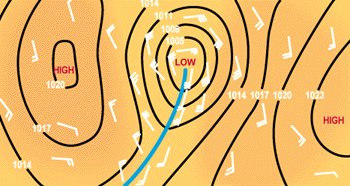
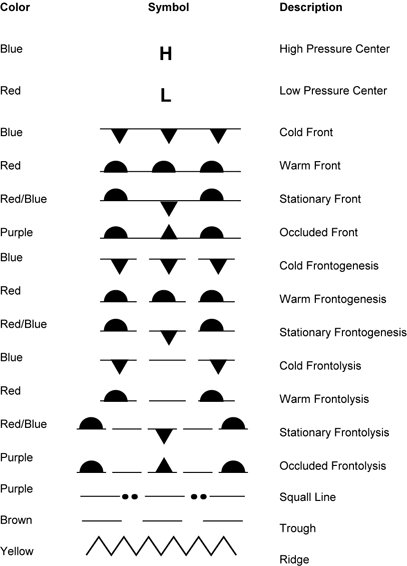
Figure 5-27 shows the development of the occluded front in greater detail. Figure 5-28 is an enlarged view of (C) in Figure 5-26, showing the cloud formations and the areas of precipitation. In figures 5-22, 5-23, and 5-25, a panel representing a surface weather map is placed below each cross-sectional view. These panels represent a bird's eye or plan view, and show how the weather conditions are recorded. A warm front is indicated by a red line, a cold front by a blue line, an occluded front by a purple line, and a stationary front by alternating red and blue dashes. The rounded and pointed projections are generally omitted from manuscript maps, but are placed on facsimile, printed, or duplicated maps to distinguish the different fronts. A frontal line on the weather map represents the position of the frontal surface on the Earth's surface. A pilot flying west at an altitude of 6,500 feet would pass through the frontal boundary about 100 miles in advance of the point where the warm front is shown, or about 25 to 50 miles to the rear of the line on the map representing the cold front. Figure 5-29 is a section of a surface weather map as transmitted on facsimile. It shows a low pressure center with warm, cold, and occluded fronts. The preceding discussion categorizes weather with types of fronts. However, weather with a front depends more on the characteristics of the conflicting air masses than on the type of front. A pilot should not attempt to determine expected weather from fronts and pressure centers on the surface chart alone. The pilot must rely heavily on other charts, reports, and forecasts which are discussed in the next section of this chapter. AVIATION WEATHER REPORTS, FORECASTS, AND WEATHER CHARTS A few reports and forecasts that are available to pilots were discussed briefly in previous portions of this chapter. This section will discuss these reports and forecasts in greater detail along with weather charts. Although pilots may often receive a telephone briefing, they should be able to read and interpret these reports, forecasts, and charts. Printed aviation data may be found at the National Weather Service Office, flight service stations, as well as reports generated through a direct user access terminal (DUAT) system. Although this section contains a great deal of information about reports, forecasts, and charts, for further information, reference should be made to AC 00-45 (latest revision), Aviation Weather Services, which is for sale by the Superintendent of Documents, U.S. Government Printing Office, Washington, DC 20402.
Aviation Weather Reports These reports provide information on existing conditions at the time the report was generated. The aviation routine weather report (METAR) provides surface weather conditions at a specified location and is presented in a coded format which is standard internationally. A pilot weather report (PIREP) is generated from information received from a pilot in flight. A RADAR weather report contains information on thunderstorms and precipitation as observed by radar. Aviation Routine Weather Report (METAR) The aviation routine weather report contains various weather elements in a coded form. The elements of the report are: [Figure 5-30]
Example:
Explanation:
Figure 5-30. -- Key to aviation routine weather report observations. KEY TO METAR (NEW AVIATION ROUTINE WEATHER REPORT) OBSERVATIONS
STATION DESIGNATOR:
TIME:
WIND:
VISIBILITY:
WEATHER:
SKY CONDITION:
TEMPERATURE/DEWPOINT-
ALTIMETER:
REMARKS:
Pilot Weather Reports (PIREPs) The pilot weather reports are a timely and helpful observation to fill in the gap between reporting stations. Aircraft in flight are the only means of directly observing cloud tops, icing, and turbulence. A pilot weather report is usually transmitted as an individual report, but can be appended to a surface report. Figure 5-31 shows the format, and how to decode the information contained in a PIREP. Most of the contractions in a PIREP are self-explanatory to use standard terminology. Example:
Explanation:
Radar Weather Reports (RAREPs) The radar weather reports provide information on thunderstorms and areas of precipitation as observed by radar. These reports include the type, intensity, intensity trend, and location of precipitation. Also included is the echo top of the precipitation, and if significant, the base echo. All heights are reported in above mean sea level (MSL). The contents of a radar weather report include:
Example:
Explanation: Fargo, ND radar weather observation at 1133 UTC. An area of echoes, four-tenths coverage, containing thunderstorms and heavy rain showers, increasing in intensity. Area is defined by points at 22°, 100 NM; 88°, 170 NM; 196°, 180 NM and 220°, 115 NM. These points, plotted on a map with straight lines, outline the area of echoes. The thunderstorm cells are moving from 240° at 25 knots. Maximum top (MT) is 31,000 feet MSL located at 162° and 110 NM from Fargo. Aviation Forecasts Forecasts especially prepared for aviation include terminal aerodrome forecast (TAF), area forecasts (FA), winds and temperatures aloft forecasts (FD), AIRMET (WA), SIGMET (WS), and CONVECTIVE SIGMET (WST). These forecasts help a pilot in flight planning and alert the pilot to any significant weather which is forecast for the intended flight. Terminal Aerodrome Forecasts (TAF) The terminal aerodrome forecasts are prepared to give a description of expected conditions at an airport and within a 5 nautical mile radius of a runway complex. A terminal aerodrome forecast is a concise statement of the expected meteorological conditions over a specified time period, usually 24 hours. Figure 5-33 provides information on the format and information contained in the TAF. The descriptors and abbreviations used in the TAF are the same as those used in the METAR report. [Figure 5-30] Explanation of figure 5-34:
Figure 5-33. -- Terminal aerodrome forecast (TAF) format.
Area Forecast (FA) An area forecast contains general weather conditions over an area the size of several states. It is used to determine forecast en route weather and to help in determining weather at airports for which TAF's are not issued. Area forecasts are issued three times a day by the National Aviation Weather Advisory Unit in Kansas City, MO for each of the six areas in the contiguous 48 states. Alaska uses a different format for their respective reports which are issued for the areas of Anchorage, Fairbanks, and Juneau. There is also a specialized FA for the Gulf of Mexico which combines both aviation and marine information, and is intended to support offshore helicopter operations. The format of an FA is:
Example:
In-Flight Weather Advisories In-flight weather advisories are unscheduled forecasts to advise aircraft in flight of the development of potentially hazardous weather. There are three types of in-flight weather advisories: SIGMET, AIRMET, and convective SIGMET. The format of these advisories consists of a heading and text. The heading identifies the issuing Weather Service Forecast Office (WSFO), type of advisory, and the valid period. The text of the advisory contains a message identifier, a flight precautions statement, and further details if necessary. Figure 5-35 shows an example of these advisories. Significant Meteorological Information (SIGMET) A SIGMET is issued to advise pilots of weather considered potentially hazardous to ALL categories of aircraft, and is valid for the period stated in the advisory. SIGMETs are based specifically on forecasts of:
Airmen's Meteorological Information (AIRMET) An AIRMET is issued to advise pilots of significant weather, but describes conditions at intensities lower than those which trigger SIGMETs. AIRMETs are issued on forecast conditions such as:
Convective Significant Meteorological Information A convective SIGMET implies severe or greater turbulence, severe icing, and low-level wind shear. A convective SIGMET may be issued for any situation which the forecaster feels is hazardous to all categories of aircraft. Convective SIGMETs are specifically based on:
|
|||||||||||||||||||||||||||||||||||||||||||||||||||||||||||||||||||||||||||||||||||||||||||||||||||||||||||||||||||||||||||||||||||||||||||||||||||||||||||||||||||||||||||||||||||||||||||||||||||||||||||||||||||